Sunday, October 21, 2007

the right man for the job

In a previous blog I expressed some anger and frustration at recent developments (Stephen Point as Lieutenant-Governor and Tsawwassen Final Agreement). Tonight, on the occasion of another group of nations approving their Final Agreements, I wish to share some additional thoughts on the nature of the Lieutenant-Governor's position and the so-called, BC Treaty Process.

The more that I think about it, there could hardly be a more appropriate person for Lieutenant-Governor than Stephen Point. He is indeed the right man for the job. First, I should explain exactly who the LG is (seeing as I'm relearning it all in POLIs 101 and 102 this semester). Prior to Canada becoming a country (officially assuming control over domestic matters in 1867), the colonies of Upper and Lower Canada (Ontario and Quebec), New Brunswick, Nova Scotia, Vancouver Island, and British Columbia were ruled by governors. These governors were the personal and practical representatives for the English monarchs (most notably a bunch of King Georges, Edwards, a William, and Queens Victoria and Elizabeth II).

The powers of the monarchs changed considerably after the 1689 English Bill of Rights. England and her imperial colonies gradually worked their way through responsible and representative governemnts until we arrived at the current liberal-democratic arrangement we have today. While the Queen no longer possesses any practical power in England or her former colonies, she retains official representatives for ceremonial purposes. In Canada, Queen Elizabeth II is represented by the Governor General in Ottawa (Michaëlle Jean), and a Lieutenant-Governer in each of the 10 provinces.

Officially, Stephen Harper is not the head of state of Canada. Queen Elizabeth II is. In fact, the Canadian Constitution makes no mention of the Prime Minister or Cabinet. Instead, it refers to the Privy Council (which used to advise the afore mentioned governors). Constitutional convention however, empowers the Prime Minister while the GG and the 10 LGs are for show only. This is my point. A lot of fuss was made about Michaëlle Jean being both a woman and a minorty (Haitian) and Stephen Point being the first indigenous LG.

Not only do they not have any real power, convention strongly suggests that they remain apolitical. No power. No politics. Lots of pomp and ceremony. It reminds me of the law-making authority provisions in the recently ratified Final Agreements (again, they are not actual treaties). While indigenous folk may make our own laws, they must conform to Canada's laws and should there be a conflict, the laws of both BC and Canada prevail in an overwhelming majority of the cases. So, we would have no real power, at least not radically different than the current state powers.

Perhaps that is the Point.

Westward the course of empire goes forth.

Monday, October 15, 2007

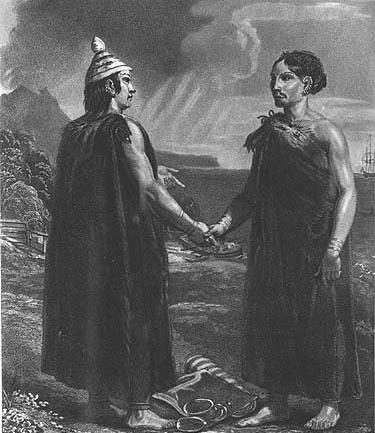
"Westward the Course of Empire Goes Forth"

A few weeks ago while shopping at the Bay Centre in Mituunii, I noticed a rather large and ornate clock suspended over the happy shoppers. I've seen it before of course, but this time something else caught my eye. Written on the side, so that you can see it quite clearly from the third and fourth levels is the phrase, "Westward the Course of Empire Goes Forth."

Indeed.

Last month the Right Honourable Stephen Harper, Prime Minister of Canada appointed former provincial court judge, BCTC Chief Commissioner, and Skowkale elected chief, Stephen Point as the Lieutenant-Governor of British Columbia. Point is the first indigenous person to be selected as the Queen's personal representative. Some hailed this an historic moment worthy of celebration. The last time I remember such Aboriginal-Settler goodwill was shortly after Premier Campbell announced the $100 million New Relationship fund, and Stephen Point spoke to the Summit chiefs about how much progress we've made "since 1969."

I guess it couldn't get any more appropriate than to have Stephen Point round out this little narrative with an LG appointment. In 2005 I disagreed with Mr. Point and now in 2007 I find myself uninspired again. Of course, you may ask, "who is he? (meaning 'me'). What has he done?" Not a lot, I must confess, but I do feel entitled to an opinion. And I am more than aware that I possess the luxury of my dissenting views because people came before me who fought for recognition against a much more overtly racist society. I respect the experiences and efforts of my elders. I respect it so much in fact that I am compelled to tell the truth as I see it. I believe that we owe that much, and if my opinions are indeed dissenting opinions than so be it.

I want to bring up a few points that came up at a meeting I attended last night in Tsartlip. The meeting was called by local community members concerned about the impending Tsawwassen Final Agreement. Two things really stood out for me. First, the passionate appeal of speaker after speaker that what is happening is not right. Being a guy like me (fairly reserved and guarded), and a student I was reminded of how visceral these issues are for people - especially as they relate how the generally esoteric matter of indigenous-settler relations impact their lives on a day-to-day, in your face basis. I struggled to hold a tear or two back several times. My chest swelled, and a very real real feeling emerged again - the need for us to stand up and fight, our duty to defend our ways of living and being in this world.

One speaker remembered a call-in radio program that was discussing the issue of Aboriginal Rights, and caller after caller, all settlers echoed a common message, "The Indians need to become more Canadian." Really? You mean like pro-actively participate in the legal system? Vote in elections? Run for the Liberal party? Learn to do business their way? Open a fish farm? Mine the earth? Help build an oil rig? Open a casino? Learn to Dance with Dollars? Dance for wealthy tourists at the Olympics? Represent the Queen, an imperial institution that has killed millions and made trillions on our own lands? Is that Canadian enough for you? After all, Canadians are so nice and polite and loved worldwide, right?

It's hard not to be sarcastic. It's hard not to be cynical. It's hard not to be angry, but should we apologize for it? Should we swallow our dignity along with everything else? Another sentiment that was shared last night by a prominent indigenous leader was that we've lost our way. In the fight for equality and respect, we gradually lost sight of who we were, are, and what we want to be. My father said that he is old enough to remember a time when all our families were self-sufficient, when everyone worked and not one person wanted for the basic needs in life. It wasn't that long ago. And after decades of court battles, political accommodation, and economic acquiescence what have we gotten for our efforts?

I realize that I do come across as angry and I have raised more questions than answers. First, I will not apologize for my anger under the guise of respect. Respect, for the self and for others demands that we speak the truth. Second, as I've said before, perhaps it is enough to say "no" and ask questions. If indeed we have lost our way, it might make sense to stop, gather ourselves, and move in a new direction. I've also said this before: Some say a bad deal is better than no deal. I disagree. If this is a game, it is serious and for all time.

Tsawwassen elected chief Kim Baird spoke in the BC legislature this morning. I could not bare to listen to it all. Disingenuous platitudes (especially by government ministers) make me ill, but I did overhear one fact that rings true. She outlined the "traditional territories" that the Tsawwassen people did not surrender.

That is, until now.

Westward the Course of Empire Goes Forth.

Friday, September 30, 2005

The Coming Storm


In my opinion, there is a significant absence of dignity in "aboriginal" politics these days. Despite the pride with which many of our politicians and bureaucrats (I’m one of the latter by the way) carry themselves there is no longer any dignity in their actions. This omission while not openly discussed is evident everywhere. For the most part, our people are detached and uninvolved in the “politics” of our communities. Our leaders accuse the majority of apathy, and the vocal minorities of negativism. The desolate and seemingly hopeless lives of many of our community members, despite a few success stories, is further evidence of a lack of genuine, dignified leadership.

The Chief Commissioner of the BC Treaty Commission (former judge Stephen Point) recently said, “we have come a long way since 1969.” As much as I like Stephen personally, I must vehemently disagree. After this statement he went on to state a variety of criteria proving our Aboriginal ascendancy – education, training, careers and such. These are all indicators of success in the mainstream society. All they prove is how assimilated we have become. In almost every major indicator of Indigenous success; language, culture, way of life, things have gotten worse and unless we do something drastic now, we are well on our way to oblivion.

Why should community members be excited about surrendering (willingly this time) 95% of their lands? Why should we agree to final primacy of neo-colonial laws? Why should we agree to indemnify the imperialists for their lies and deceit and treachery for a few million dollars and tax bills? Many of us have watched our way of lives – fishing, hunting, trapping – disappear and be replaced with tourists, whale watching and oil rigs. How the hell are we supposed to get excited about that?

The last time the Indigenous people of this country collectively felt excitement, hope and dignity on a grand scale was in 1990. Many who were not raised strongly Indigenous, in fact many who lived as “undercover brothers” suddenly stuck their heads up, puffed their chests out because of the actions of their Mohawk brothers and sisters. People were moved. Many became born-again Indians. Since then other conflicts, perhaps to a lesser extent, have had similar effects, and our leadership have become increasingly co-opted.

We felt proud because someone was willing to fight, to take a stand. We felt proud because finally, someone (who looked like us) had had enough. Negotiation (especially from profound positions of weakness) does not inspire. Paying non-Indigenous lawyers copious amounts of money to argue facts we already know does not inspire. Mimicking mainstream society in our band politics does not inspire. Action inspires. Standing up and saying enough is enough inspires.

A storm is coming. Treaty commissioners, Indian Act Chiefs, negotiators, consultants, lawyers, and brown bureaucracies be damned, a storm of Indigenous dignity, hope and action is coming.